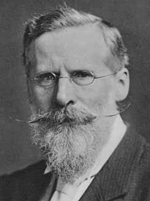
|
“I am
attacked
by two
very
opposite
sects
– the
scientists
and
the
know-nothings.
Both
laugh
at me,
calling
me
‘the
frogs’
dancing
master’.
Yet I
know a
have
discovered
one of
the
greatest
forces
in
nature”.
Galvani,
discoverer
of
electricity
William
Crookes
was
born
on 17
June,
1832
in
London
. He
studied
at the
Royal
College
of
Chemistry
and
became
one of
the
most
important
scientists
of the
XIX
century,
both
in the
field
of
Physics
and in
Chemistry.
He
combined
private
experimental
research
with
business.
He
also
edited
several
photographic
and
scientific
journals.
Having
inherited
a
large
fortune
from
his
father,
he
devoted
himself
from
1856
entirely
to
scientific
work
of
various
kinds
at his
private
laboratory
in
London
. In
1861,
he
discovered
the
metallic
chemical
element
thallium.
This
led
him
indirectly
to the
invention
of the
radiometer
in
1875.
He
later
developed
a
vacuum
tube (the
precursor
of the
X-ray
tube).
His
studies
of
cathode
rays
were
fundamental
in the
development
of
atomic
physics.
He was
knighted
in
1897
and
received
the
Order
of
Merit
in
1910.
He was
also a
Fellow
of the
Royal
Society,
becoming
its
president
between
1913
and
1915.
Spiritist
phenomena
were
very
much
in
evidence
at the
end of
the
XIX
century.
After
the
events
involving
the
Fox
sisters
of
Hydesville,
in
1854
in the
United
States
,
there
appeared
several
mediums
displaying
the
most
incredible
phenomena
like,
levitations,
rappings,
the
spontaneous
playing
of
instruments,
materializations,
etc.
Therefore,
William
Crookes,
as a
scientist
of
international
repute,
decided
to
investigate
Spiritualism.
He was
initially
very
sceptical
about
it. He
explained
the
reasons
for
his
inquiry:
‘I
consider
it the
duty
of
scientific
men
who
have
learnt
exact
modes
of
working
to
examine
phenomena
which
attract
the
attention
of the
public,
in
order
to
confirm
their
genuineness
or to
explain,
if
possible,
the
delusions
of the
dishonest
and to
expose
the
tricks
of
deceivers’.
By his
own
account
Crookes
had
originally,
‘like
other
men
who
thought
little
of the
matter
and
saw
little’,
taken
Spiritualism
to be
superstition
and
trickery;
he
stressed
that
his
aim
would
be to
substitute
a
strictly
scientific
appraisal
‘for
the
loose
claims
of the
pseudo-scientific
Spiritualists’.
He
began
by
studying
one of
the
most
famous
mediums
of all
time,
Daniel
Dunglas
Home,
and
was
soon
convinced
that
Home
was
endowed
with a
powerful
psychic
force.
Many
believed
that
Crookes
would
expose
the
phenomena
he
witnessed,
but
this
rapid
conversion
to the
ranks
of
believers
surprised
the
public
and
shocked
his
scientific
colleagues.
Yet he
undertook
all
his
experiments
under
strict
scientific
conditions,
whenever
that
was
possible.
He
devised
instruments
to
preclude
any
possible
claim
of
forgery.
For
example,
he had
a wire
cage
made
and
inside
it, he
put an
accordion
he had
bought
himself.
Home
just
placed
his
hand
on the
cage
and
the
instrument
started
to
play a
well-known
tune.
The
experiments
that
made
him
really
famous
were
with
the
medium
Florence
Cook,
at the
time,
only a
teenager.
Through
her
mediumship,
there
occurred
a
series
of
materializations
of the
Spirit
Katie
King,
which
lasted
almost
three
years.
Just
before
the
Spirit
stopped
appearing,
Crookes
obtained
a
total
of 44
photographs,
among
which
were,
according
to him,
‘some
inferior,
some
indifferent,
and
some
excellent’.
When
Crookes
started
to
report
about
his
experiments
to the
scientific
community,
he
found
unrestrained
hostility.
He was
even
accused
of
complicity
with
Florence
Cook,
and of
having
an
affair
with
her.
Yet,
he
never
changed
his
mind
about
the
reality
of
Spirit
phenomena.
In his
presidential
address
to the
British
Association,
in
1898,
he
said:
‘Thirty
years
have
passed
since
I
published
an
account
of
experiments
tending
to
show
that
outside
our
scientific
knowledge
there
exists
a
Force
exercised
by
intelligence
differing
from
the
ordinary
intelligence
common
to
mortals.
I have
nothing
to
retract.
I
adhere
to my
already
published
statements.
Indeed,
I
might
add
much
thereto.”
Sir
William Crookes
died
in
London
on 4
April
1919 . |